
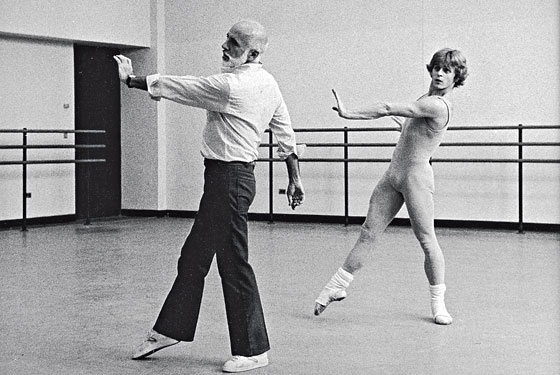
Over the last few days I’ve reconnected with my past in dance. Spending time in a studio with people making stuff creates a bond that lasts decades, and here I was again with people from 40 years ago, not making new work, but reflecting on what that time together in the studio meant.
There were two moments especially that reminded me about the freedom of a dance studio and gave a clue to why I can at times find the constraints of the boardroom, arguably another space for creative ideas, mystifying.
One moment was a description by one of the UK’s leading choreographers giving an account of handing on a solo they had created to another dancer. In it she described the level of risk the dancer needed to take, the degree to which they should push the edge of uncertainty of being off balance, while also hitting the music on time. And in so doing, making mistakes time and again, until finally they made the work their own through discovery.
The second moment is in the notes of this season’s London City Ballet programme where its Artistic Director, Christopher Marney, writes:
“…great choreography is rarely about movement alone. A quiet thought, a shift in intention or a single image can transform an entire performance, allowing dancers to discover rather than simply execute”.
It’s that idea of “simply execute”, that rattled and made the connection for me from my old world of dance to the new world of boardrooms, both private and third sector. In what Camilla Cavendish described in The Financial Times on 18 September 2026, ‘The Relentless Creep of Britain’s Compliance State’, “…we have seen compliance culture undermining professional judgement,” I wonder how often we’re in a room together only to “execute” rather than create?
We’re surrounded by compliance, from the Charities Commission, OFS, Ofsted and ISI, the FCA and PRA, various codes in industry sectors from sport to media, and risk registers that run to several pages and take hours to review. All of which come with penalties if breached, from significant fines to business failures, and reputational damage from which it can be hard to recover.
What could we learn from the dancer’s studio that might release that tension and make us freer to think and discover?
For one thing, great dance and great dancers thrive where there is absolute trust to express ideas, in what we might nowadays call an environment of psychological safety. They thrive also when there is jeopardy of some kind, where the limits of an idea might be pushed until it fails. This can happen in a studio, safely and very often with humour, because these are spaces designed with that behaviour in mind.
I sometimes wonder as I listen to the conversations around Britain’s board rooms how safe people feel to say what they really think. Maybe that also says a lot about me, and my innate desire to break the rules of convention and blurt things out. In this age of compliance, where the possibility of verbatim recordings of meetings might be subject to Data Access Requests, where every decision is couched by what some future regulator or frustrated stakeholder or angry customer might seek to investigate, our ability to really explore an idea, creatively, can feel constrained. Some might say for good reason, too. It is a level of security against rogue actors, but I’m not entirely convinced it makes for better decisions.
Where is the moment for the ‘what-ifs’, and the ‘how abouts’ within the lengthy agendas, always with an eye to compliance? How much of what is said is mediated? How often are people trying to read the room, or the unsaid, and relying on that to make a judgement? Of course, people do sometimes express an idea, or give a perspective, yet how often are these potential gems of thought followed up, or bottomed out? Time disallows this freedom to explore and discover among the demands of business as usual.
Boardrooms are also their own form of performative spaces. They have their own rules of behaviour, sometimes articulated formally, and more often tacitly understood or assumed. They have their own overture, where the key themes are set out and then developed over the hours that follow. They have their various actors, to quote Shakespeare, who “… have their exits and their entrances”. At best they have a narrative arc that connects one idea to another. By the time the board meets, the rehearsal for the agenda has already happened, elsewhere, and offline, and not always with all the participants.
I wonder how much boards and their executives might benefit from getting some studio time, off the agenda, where ideas can be safely floated and tested, where risk and excitement of the possible might be given flight, and where deeper fears can be surfaced.
No, not a strategy day, but a day together, in a space without agenda and see what happens. Trust, for one thing, might strengthen. That sense of being a ‘company’ that dancers and actors know deeply because they have spent time out of the spotlight trying things out together, makes them stronger. Then the work has a platform to really transform.