
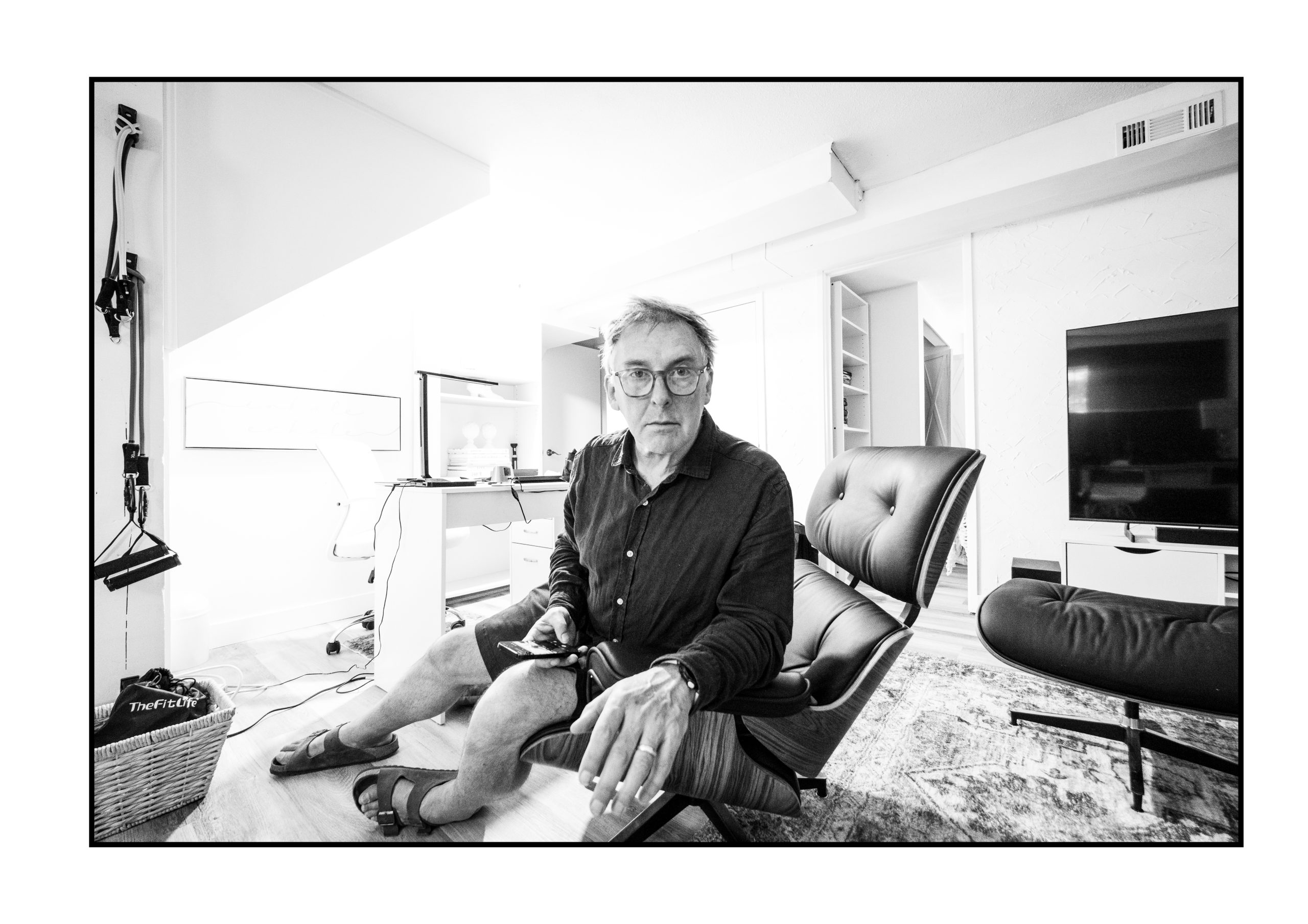
This is a self-portrait taken recently in the basement of what was my mum’s apartment in Canada for around 30 years (she’s moved out to a new place). It is the kind of photograph that might appear on a photo tribute one day, but I won’t be around to select those images, so who knows?
Self-portraits are an act of vanity to some extent, but they are also a document of a point in time, and when seen as part of a chronological narrative something vivid comes alive.
Dutch master, Rembrandt van Rijn, was a painter, printmaker, and draughtsman. He is unusual in that he made almost one hundred self-portraits, using the technology of the day that he had to hand. From his mid-twenties until just months before his death in 1669 aged 63, he returned again and again to his own face. He painted his own picture dozens of times over decades, so that it is the sequence rather than individual images that becomes the meaning.
Some critics have argued that his works mark a certain narcissistic self-absorption, while others, with reference to his later portraits, suggest a coming to terms with his own mortality. Either way, they are remarkable images that trace a lifetime of intense searching. They would also have been part of the daily business of creating and staying on top of his craft through experimentation and practice. There is a whole other discussion to be had about the act of creation as an important part of how we construct ideas, think about, and make sense of the world, and our place in it.
Some years ago, my wife and I took to making 10 minute sketches every day. Our ambition was to do this for a year. We managed about 8 months, and each month we would take on a different subject, from kitchen utensils to food. One month the subject was each other.
To really look is a powerful thing to do. Try it. Take a sustained look at someone’s face and think about how you might capture that. Draughting by pencil, or direct with paint has a unique quality because it is a physical act. Photography can be fleeting, but it can also be studied and carefully thought about. Either way, have a good look. How would you capture them? Now, try that with your own face and relax into it.
What you see today, will not be there in a few weeks, months, or years’ time, and what you see will be determined by your own relationship with time, and your values at that moment. Rembrandt, some argue, produced his best work in his final chapters of his life. He had experienced bankruptcy, the loss of immediate family, and this seemed to concentrate rather than diminish his artistic powers.
Scholar’s write about Rembrandt’s late style as something qualitatively different from what came before, more free, bolder, and less concerned with surface and more interested in what lies beneath.
One of the things I notice in working with senior leaders is that they are very often in the compression of their jobs. Leaders in their late forties or fifties can be the least reflective about time. They are too busy to look, to really look. The future feels abstract, or scary, something to be planned for at best, and the present is to be inhabited and managed.
In my role as a funeral celebrant, I watch dozens of photo tributes, which telescope a life into a matter of minutes. There are unnervingly moving, every time. Even if you have never met them.
Tempus Fugit and all that is not experienced evenly, it is much more like ground rush.